

GLA 2024-based population projections - research outputs
Summary
The GLA’s 2024-based demographic projections will be a key part of the evidence base for the next London Plan. Final projections are expected to be published at the beginning of 2026, but the GLA has published an initial set of trend-based population projections – labelled ‘research outputs’ – to give users an early indication of the draft results and an opportunity to provide feedback on them*.
The range of London’s projected future population is much narrower in these new projections than is the case with the 2022-based outputs, with the lower end of the range being much higher than before. This is a consequence of the projections incorporating the newly published ONS mid-year population estimates which showed two years of increased international migration inflows.
Final outputs, including housing-led population projections are expected to be published early in 2026.
*please contact demography@london.gov.uk with any feedback
About the projections
Following the release of the the 2024 mid-year population estimates by ONS on 30 July, the GLA has produced an initial set of population projections based on these data. The 2024-based projections are intended to be a key part of the evidence base for the next London Plan. For now, these projections are badged as ‘research outputs’ and they have been published so that planners, policymakers, and others have early sight of the results. The projections are available to download from the London Datastore here.
The designation as research outputs reflects that:
- The outputs have not yet been quality assured and are subject to change
- We have not yet committed to the model configurations and variants for the final projections
- The outputs are incomplete as we cannot yet produce corresponding housing-led projections
- We have not yet produced accompanying methodology and results documentation
-
We want to to offer users the chance to provide feedback on the projections, e.g.:
- Potential issues and errors in the projections
- Suggestions for additional/different variants
- Preferences for the content and format of output data
Contents of the release
This initial release includes both summary outputs in Excel workbooks, and more detailed data in CSV files for the three ‘core’ projections and four additional variants. The variants are named using the following convention (largely borrowed from that used by ONS to name variants in the National Population Projections), which describes the base year and key assumptions used in the model:
[base year]_[fertility assumption][life expectancy assumption][migration assumption]
-
Core projections
- 2024_ppt_10yr – principal fertility, principal life expectancy, 10 years past migration
- 2024_hht_15yr – high fertility, high life expectancy, 15 years past migration
- 2024_llt_5yr – low fertility, low life expectancy, 5 years past migration
-
Additional variants
- 2024_hht_10yr – high fertility, high life expectancy, 10 years past migration
- 2024_llt_10yr – low fertility, low life expectancy, 10 years past migration
- 2024_ppt_5yr – principal fertility, principal life expectancy, 5 years past migration
- 2024_ppt_15yr – principal fertility, principal life expectancy, 15 years past migration
Note: The same Datastore page also includes outputs from the 2023-based projections, which were used for some internal purposes, but which we decided against giving ‘full’ status to due to the added uncertainty created by revisions to Long Term International Migration estimates.
Some headline results
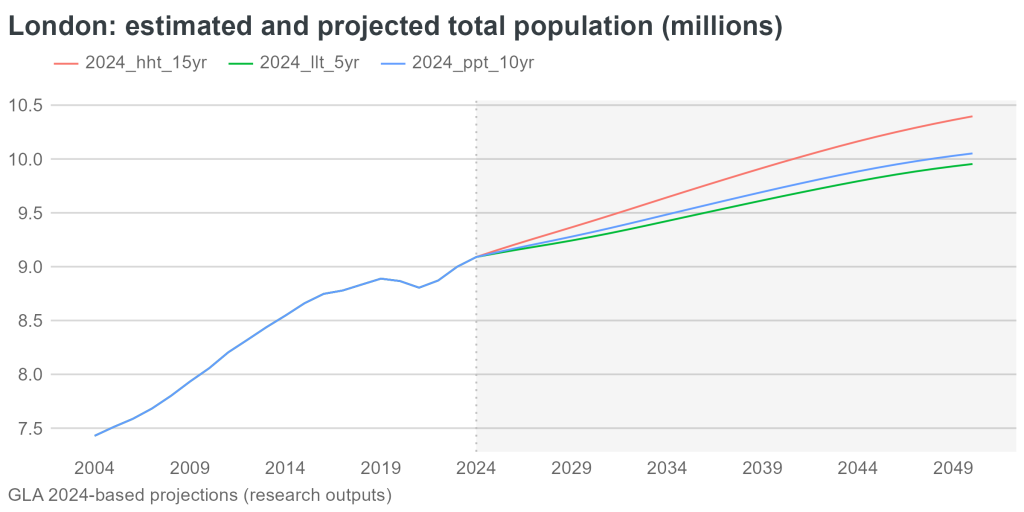
Across the three core variants, London’s total population is projected to reach between 9.86 million (2024_llt_5yr) and 10.25 million (2024_hht_15yr) by 2046. The top end of this range is only marginally above the level seen in the 2022-based projections (10.17 million), but the lower end is very much higher than the equivalent 2022-based figure (9.26 million). This upward shift in the lower outcome is a consequence of two years of high international migration, which has a greater impact on in the projections based on 5 years of past migration data than it does on those based on longer periods of trends.
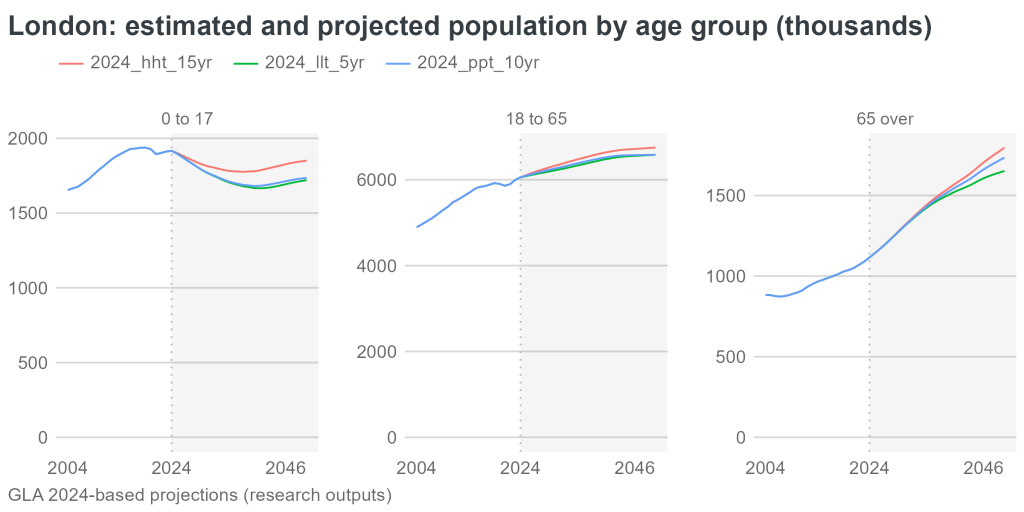
For the same reason, the range of projected population of under 18s and working age adults is much narrower in the 2024-based projections than it was in the 2022-based outputs. The wider range in the projected population aged 65 and over is due to the use of different life expectancy assumptions across the three projections, whereas all variants of the 2022-based used the same set of assumptions.
Housing-led projections
We hope to publish 2024-based housing-led population projections early in 2026 – alongside finalised versions of the trend-based outputs. Production of the projections is contingent on the availability of two key sets of data:
Small area population estimates
Following the revisions to UK Long-Term International Migration estimates in autumn 2024, ONS postponed the release of the the 2023 Small Area Population Estimates, which are a key input to the GLA’s housing-led projections. ONS have indicated that estimates for both 2023 and 2024, together with revised data for 2022, will be published in Autumn 2025.
Updated housing trajectories
Current housing-led projections use assumptions about the quantity, timing, and spatial distribution of future development that are based on the 2017 Strategic Housing Land Availability Assessment (SHLAA). We expect to update the housing assumptions used in the models later this year and incorporate data from the new SHLAA, which is currently under development.
Household projections
Draft household projections created using the 2023-based population projections were published on the Datastore in June. Updated household projections using the 2024-based population projections will be added in the coming weeks.